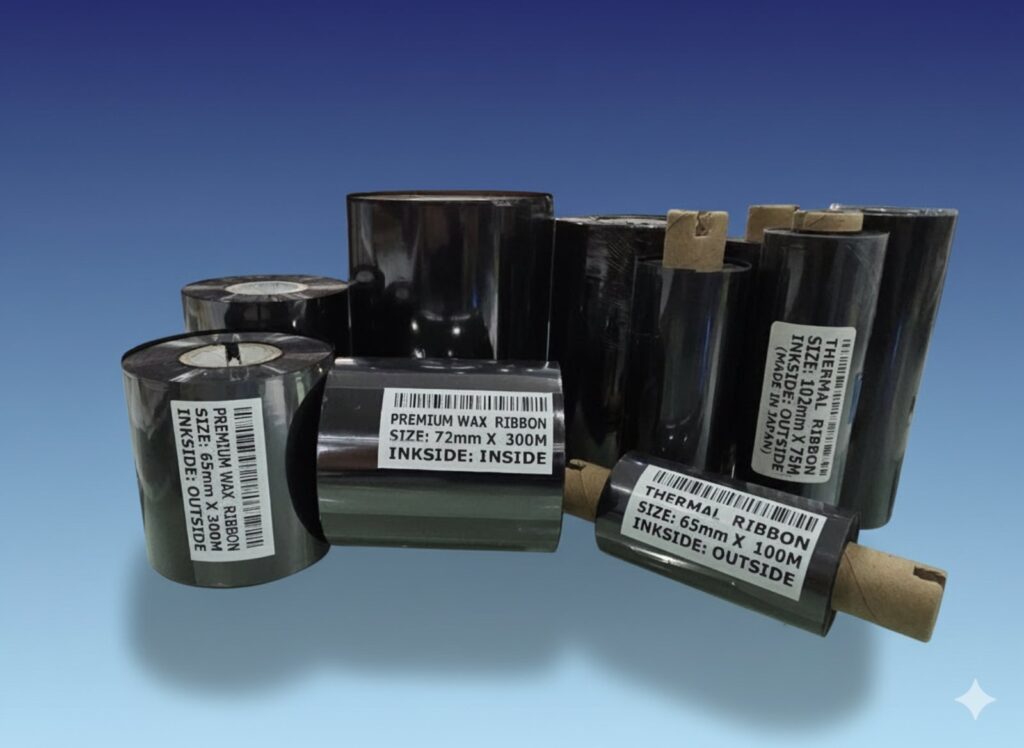
Description
How It Works
Inside a thermal transfer printer, the ribbon and the label material move together beneath a printhead. The printhead contains many small heating elements, or pixels, that heat up in specific patterns based on the digital image or text file.
- Heating:The printhead elements heat up instantly, pressing the ribbon against the label.
- Melting & Transfer:The heat melts the ink-based coating on the ribbon.
- Adhesion: The melted ink is immediately transferred from the ribbon’s film carrier onto the label’s surface, where it cools and solidifies, forming a stable and permanent image.
The Structure of a Ribbon
A thermal transfer ribbon is more than just a simple roll of ink. It’s a multi-layered polyester film engineered for performance and reliability.
- Back Coating: This top layer is in direct contact with the printhead. Its primary job is to reduce static and friction, protecting the printhead from abrasion and ensuring the ribbon travels smoothly.
- PET Film Base: This is the core substrate, providing the strength and flexibility for the ribbon.
- Release Layer: This layer helps the ink cleanly separate from the film base upon melting.
- Ink Layer: This is the functional layer that gets transferred to the label. The composition of this layer determines the ribbon’s type and its specific properties.
Types of Thermal Transfer Ribbons
The ink layer’s formulation is the key differentiator between ribbons. Each type is designed for different applications, balancing durability with cost.
Wax Ribbons
This is the most common and cost-effective type of ribbon. The ink is made primarily from a wax-based formula.
- Best For: Standard, short-term applications like shipping labels, retail tags, and general-purpose product identification.
- Prints On: Uncoated or matte coated paper labels.
- Characteristics: Requires lower heat settings to print, which extends printhead life. However, the resulting print is less durable and can be susceptible to scratching, smudging, and chemicals.
Wax-Resin Ribbons
These ribbons contain a hybrid of wax and resin in their ink layer, offering a great balance between durability and price.
- Best For: Applications requiring more durability than wax can offer, such as shelf labels, pharmaceutical labels, and tags exposed to moderate handling.
- Prints On: Coated paper and some synthetic (plastic) labels.
- Characteristics: Creates a sharper, more durable image than wax alone. It offers good resistance to scratching and smudging and can withstand mild chemical exposure.
Full Resin Ribbons
Formulated with pure resin, these are the most durable and highest-performance ribbons available.
- Best For: Harsh environment applications where labels must withstand extreme conditions. This includes medical device and component labeling, chemical drum labels, and outdoor applications.
- Prints On: Top-coated synthetic materials like polyester, polypropylene, and vinyl.
- Characteristics:Creates an extremely durable print that is highly resistant to scratches, abrasion, chemicals, solvents, and extreme temperatures. This performance comes at a higher cost
Ribbon Ink coating direction
The terms “inkside” and “outside” refer to how a thermal transfer ribbon is wound onto its core. Simply put, it describes which side of the ribbon film the ink coating is on.
- Inkside (or Coated Side In / CSI):The ink coating is on the innersurface of the ribbon as it’s wound on the roll.
- Outside (or Coated Side Out / CSO): The ink coating is on the outer surface of the ribbon.
Choosing the correct one is crucial because printers are specifically designed to work with one type or the other.
Why Does It Matter?
A thermal printer’s printhead and ribbon spindles are engineered to create a direct path where the ink layer makes contact with the label.
- If you load an outside wound ribbon into a printer designed for an inside wound ribbon, the blank polyester side of the ribbon (the back coating) will face the label. The printhead will heat the ink, but no ink will transfer, resulting in blank labels.
- Conversely, loading an inside wound ribbon into a printer expecting an outside wound ribbon will also result in a failure to print.
Printer Compatibility
The type of winding required is determined by the printer manufacturer and model. While there are exceptions, here is a general guide for some major brands:
- Inkside (Coated Side In): Most printers from manufacturers like Sato, Datamax, and TECtypically use inkside wound ribbons.
- Outside (Coated Side Out): This is the most common winding direction. Printers from brands like Zebra, Intermec, and TSC almost always use outside wound ribbons.
Always check your printer’s manual or the manufacturer’s specifications to be certain.
How to Tell the Difference
If you have a roll of ribbon and you’re not sure which type it is, here are two simple tests you can perform:

The Tape Test (Most Reliable)
- Take a piece of regular sticky office tape and press it firmly onto the outer surface of the ribbon roll.
- Peel the tape off.
- If black ink flakes come off onto the tape, it’s an outside (CSO) ribbon. If nothing comes off, it’s an inkside (CSI) ribbon. You can confirm this by unrolling a small section and pressing the tape to the inner surface, where it should pick up ink.
The Fingernail Scratch Test
- Unroll a small piece of the ribbon.
- Gently scratch the outer surface with your fingernail.
- If the scratch leaves a black mark on the film, it is an outside (CSO) ribbon.
- If not, try scratching the inner surface. If it leaves a mark, it’s an inkside (CSI) ribbon.